



RS485 encoder communication is widely used in industrial automation because it offers stable differential transmission and good anti-interference capability. However, field communication problems are often caused not by the encoder itself, but by incorrect grounding and shielding practice. In many installations, unstable position data, intermittent communication loss, or random bus errors can be traced back to poor cable treatment rather than protocol failure.
RS485 uses a differential signal pair, which already improves noise resistance compared with single-ended communication. Even so, the communication quality still depends heavily on how the cable is routed, shielded, and grounded. A differential pair is not immune to all interference, especially in environments with motor drives, inverter output cables, switching power supplies, and long cable runs.
The first practical rule is that the RS485 communication pair should be kept consistent. Twisted-pair cable is normally required for the signal lines because it helps maintain signal symmetry and reduces electromagnetic coupling from nearby power circuits. If the signal pair is untwisted, extended incorrectly, or split across unrelated conductors, communication reliability will drop quickly, especially when baud rate or distance increases.
Shielding is intended to reduce external interference, but it only works properly when the grounding method is correct. In industrial systems, the shield is usually connected according to the cabinet grounding concept rather than treated as an ordinary signal conductor. If the shield is left floating in a noisy environment, its protective value becomes limited. If it is grounded carelessly at multiple points without considering system potential differences, it can introduce unwanted current paths and increase noise sensitivity.
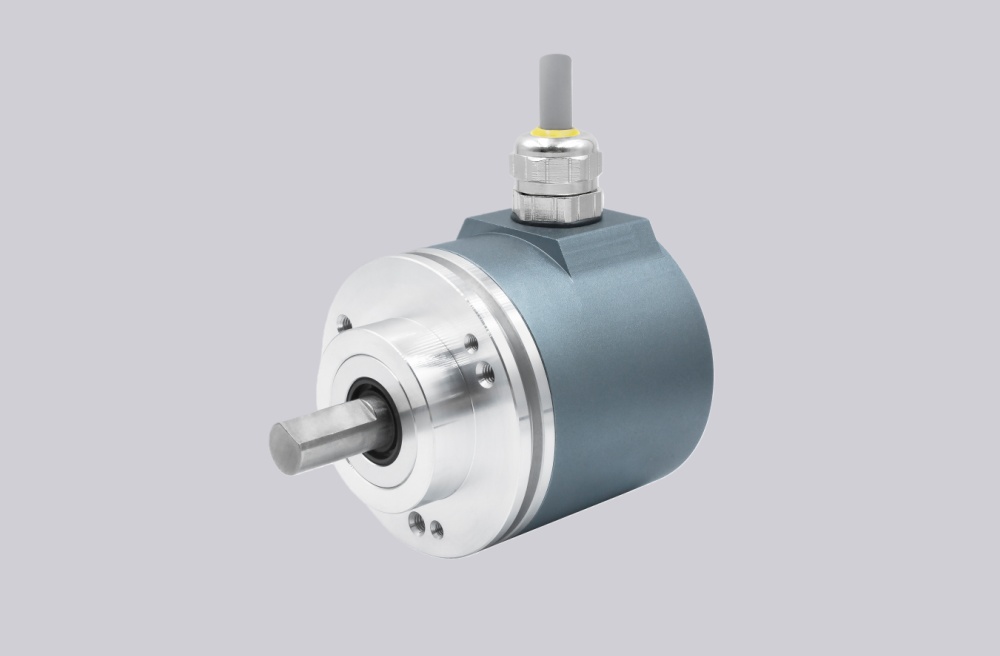
In practice, a common engineering approach is to follow the grounding strategy already used by the control cabinet and communication network. The important point is consistency. RS485 encoder grounding should not be improvised on site without regard to the rest of the system. A well-designed grounding concept is more effective than simply adding extra shield connections.
Cable routing is another important factor. Even with correct shielding, communication cables should not be routed directly alongside motor power lines, brake cables, or inverter output wiring for long distances. Parallel routing close to high-power cables increases the chance of induced noise. In many field cases, separating the communication cable path from power wiring solves problems that were initially blamed on encoder faults.
Ground reference should also be considered. Although RS485 is differential, the system still benefits from stable electrical reference conditions. Large ground potential differences between devices can reduce communication robustness. This becomes more important in larger machines, distributed cabinets, or installations spanning long distances.
In commissioning, grounding and shielding problems often appear as inconsistent faults. The encoder may work normally at low speed or short test runs, then show errors during full operation when drives, motors, or switching loads become active. This is why communication testing should be done under realistic operating conditions rather than only during idle bench checks.
From a practical maintenance perspective, several checks are useful:
- confirm twisted-pair continuity for the signal lines
- inspect shield termination at the cabinet side
- verify cable separation from power circuits
- check whether grounding is consistent across the system
- review whether communication faults appear under load conditions
RS485 encoder communication is usually reliable when installed correctly. Good grounding and shielding practice do not require complicated theory, but they do require discipline. In industrial environments, stable communication depends as much on cable treatment and grounding concept as on the encoder interface itself.