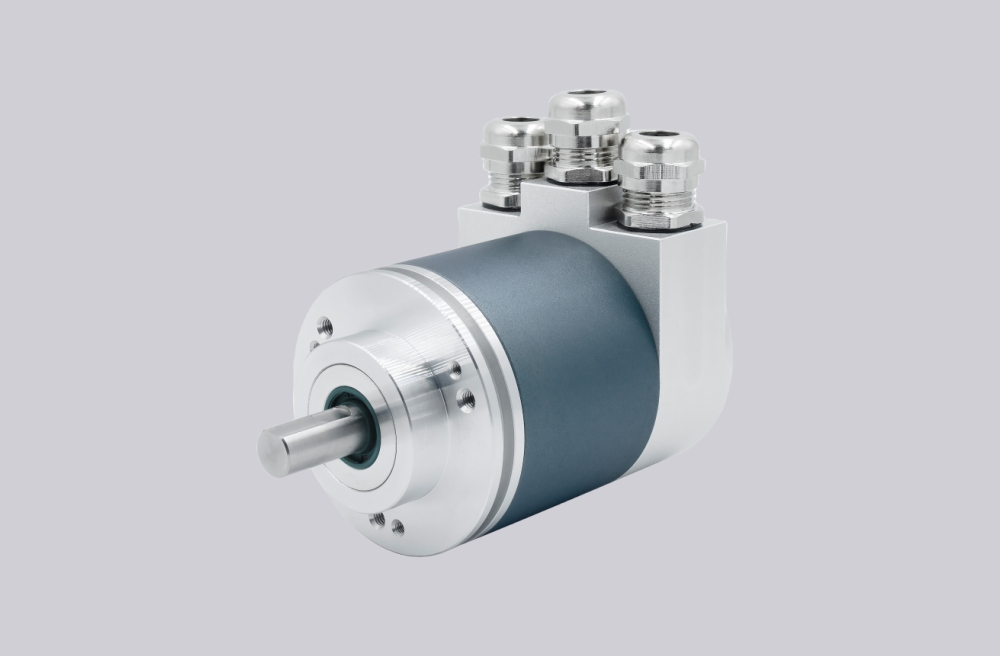





SSI (Synchronous Serial Interface) is a widely used communication method for absolute encoders in industrial systems where stable, deterministic position feedback is required. Unlike fieldbus-based solutions, SSI is typically used for direct point-to-point communication between the encoder and the controller, making it suitable for applications where system simplicity and predictable timing are more important than network-level functionality.
The working principle of SSI communication is based on a clock-driven data transmission mechanism. The controller generates a clock signal, and the encoder responds by outputting position data sequentially, bit by bit. In this structure, the encoder does not initiate communication independently. Instead, all data transmission is synchronized with the controller clock, ensuring deterministic and repeatable timing behavior.
The transmitted data represents the encoder’s absolute position in binary format. For absolute encoders, each position corresponds to a unique digital value, allowing the controller to obtain position information immediately after power-up without requiring reference movement or pulse counting. This characteristic is particularly important in systems where startup position must be known without re-homing.
Signal structure is a critical aspect of SSI integration. In most industrial implementations, differential signaling (such as RS422 levels) is used for both clock and data lines to improve noise immunity. This is especially relevant in environments with long cable runs, high electrical interference, or proximity to motors and drive systems. In practice, signal stability often depends more on wiring quality and installation conditions than on interface specification alone.
The data frame structure is determined by encoder resolution and configuration. A single-turn encoder outputs a fixed number of bits representing one revolution, while a multi-turn encoder includes additional bits to represent rotation count. The controller must be configured to read the correct bit length and interpret the data structure accurately. A mismatch in bit alignment or data length may not interrupt communication, but can result in incorrect position values.
Timing behavior is another important factor in SSI systems. The clock frequency defines the data transmission rate, but higher speeds also increase sensitivity to cable quality, transmission distance, and environmental noise. In practical applications, stable communication is achieved by balancing clock frequency with cable conditions and installation environment rather than simply maximizing data rate.
Although SSI is relatively simple compared with fieldbus systems, integration still requires careful attention to signal alignment and configuration. Clock polarity, data sampling edge, and synchronization timing must match between the encoder and controller. In many cases, communication appears normal at the signal level while position data remains incorrect due to configuration mismatch.
SSI does not provide advanced diagnostics, addressing, or device management features. This makes it lightweight and predictable, but also means that troubleshooting relies more on signal verification, wiring inspection, and parameter checking rather than protocol-level diagnostics.
From an engineering perspective, SSI is typically selected when direct position reading, deterministic timing, and simple system structure are required. It is less suitable for distributed multi-device networks, where bus-based protocols such as CANopen or PROFIBUS provide better scalability and system management capabilities.
In practical system design, the effectiveness of SSI communication is determined not by interface complexity, but by how well signal wiring, timing configuration, and data interpretation are matched within the control system. A correctly integrated SSI encoder often provides more stable performance than more complex communication solutions that are not fully aligned with the application.
This article explains the working principle and signal structure of SSI encoders and highlights the key considerations for achieving stable integration in industrial environments.