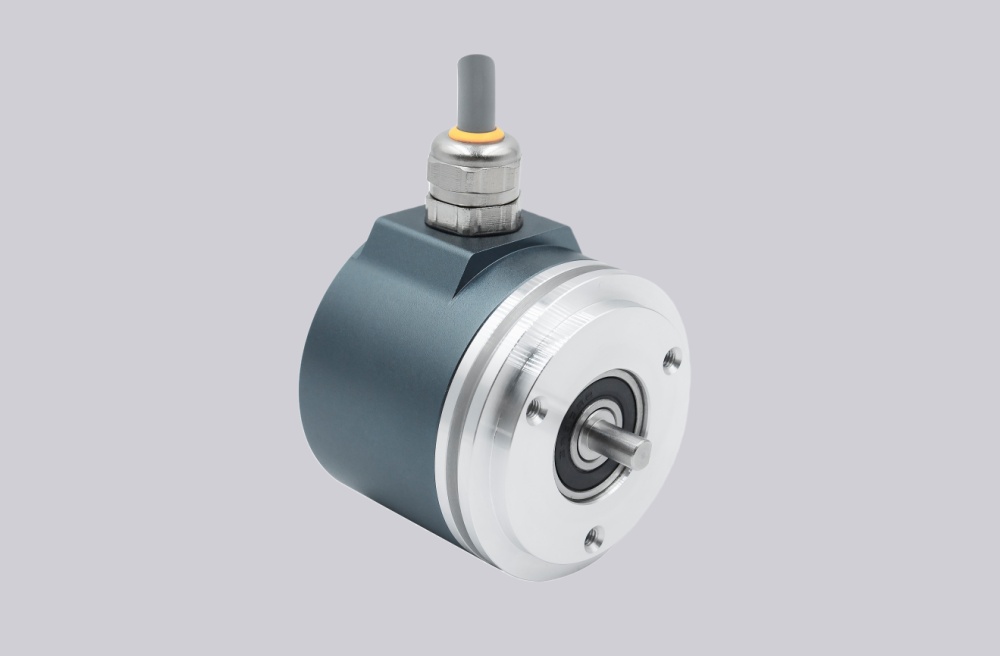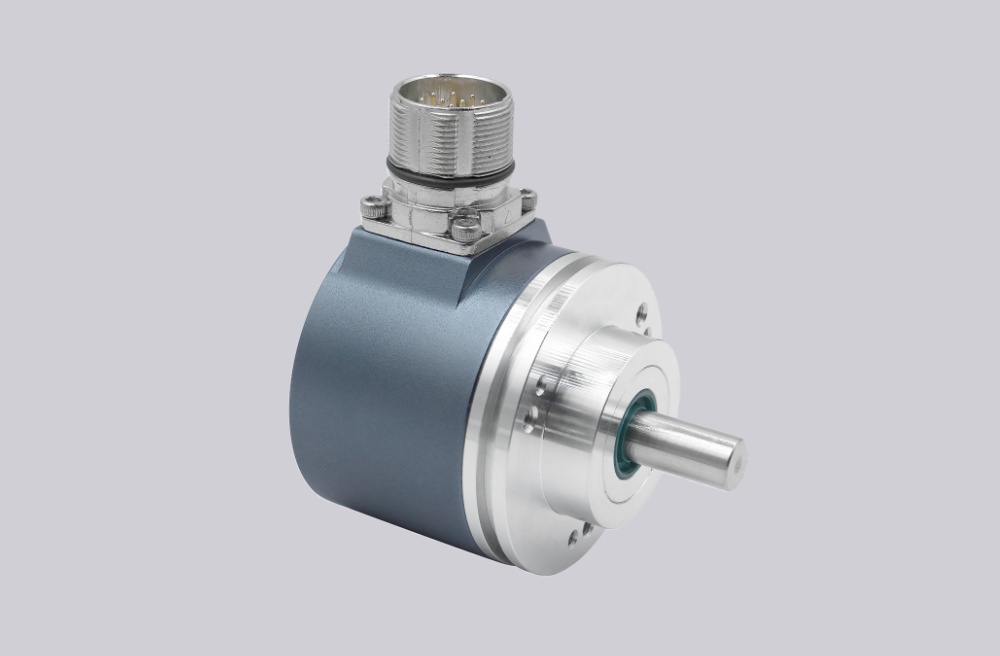





In industrial motion control, one of the most common selection questions is whether an application should use an absolute encoder or an incremental encoder. At first glance, both devices are used to detect position, speed, or movement. In practice, however, their signal logic, data behavior after power loss, installation expectations, and system integration requirements are very different.
Understanding this difference is important because the wrong encoder type can create unnecessary complexity in PLC programming, commissioning, homing, signal processing, and fault recovery. In some applications, an incremental encoder is fully sufficient and cost-effective. In others, only an absolute encoder can provide the position reliability required by the machine.
Basic Working Principle
An incremental encoder generates pulses as the shaft rotates. The control system counts these pulses to determine movement. Typical output channels include A, B, and sometimes Z. The A/B signals indicate direction and pulse count, while the Z pulse provides one reference point per revolution.
An absolute encoder works differently. Instead of only outputting pulse changes, it provides a direct position value. Each shaft position corresponds to a unique code. Even if the machine stops and power is removed, the encoder position can still be identified again when power returns, depending on the encoder type and system design.
This is the most fundamental difference:
- An incremental encoder reports movement change.
- An absolute encoder reports actual position.
Power Loss Behavior
Power interruption is often the point where the practical difference becomes obvious.
With an incremental encoder, the controller must count pulses continuously. If power is lost, the accumulated count may be lost as well unless the system has memory retention or battery-backed control logic. After restart, the machine often needs a homing or referencing process before normal operation can resume.
With an absolute encoder, the position value is directly available again after restart. A single-turn absolute encoder identifies the position within one revolution. A multi-turn absolute encoder identifies both angular position and the number of turns over a larger travel range.
For machines where restart position matters, this difference is critical. Lifting systems, indexing tables, servo axes, automated storage equipment, and many positioning systems benefit from the restart reliability of absolute feedback.
Signal and Interface Differences
Incremental encoders are usually simpler in signal structure. Common output forms include TTL, HTL, push-pull, or open collector pulse signals. The receiving controller reads pulse frequency for speed and pulse count for position. Wiring is often straightforward, but signal quality becomes important at high speed, long cable distance, or electrically noisy installations.
Absolute encoders usually transmit coded position data through interfaces such as SSI, RS485, CANopen, Profibus, Profinet, EtherCAT, or other industrial communication methods. These interfaces allow the controller to read exact position data rather than reconstruct it from pulses.
From an engineering perspective, this means:
- Incremental encoders are often easier to integrate in basic pulse-counting systems.
- Absolute encoders usually provide richer position information but require interface matching with the control platform.
Installation and Commissioning Considerations
Incremental encoder systems often need more commissioning attention because the pulse count must align correctly with mechanical travel, counting direction, and reference logic. If the wiring polarity is wrong, shielding is poor, or the controller counts incorrectly, the system may show reversed direction, unstable count, or accumulated position error.
Absolute encoders can reduce some of that commissioning effort because the control system reads a defined position value directly. However, they are not automatically easier in every case. Engineers still need to confirm protocol compatibility, code format, resolution, turn count, update speed, and communication settings.
In short:
- Incremental systems can be simpler in hardware but may require more care in pulse interpretation and homing logic.
- Absolute systems can simplify position recovery but require stricter protocol and data compatibility.
Which One Is Better for Speed Feedback?
For speed detection alone, incremental encoders are still widely used and often remain the more practical option. Pulse frequency is easy to process, and many drives, counters, and PLC high-speed inputs are designed specifically for incremental feedback.
That said, absolute encoders can also support speed-related applications, especially in advanced motion systems where the controller already uses fieldbus communication and needs exact position data together with diagnostics or multi-axis synchronization.
If the application mainly needs rotational speed, direction, and basic motion feedback, an incremental encoder is often sufficient. If the application needs exact position retention, coordinated positioning, or network-level feedback, an absolute encoder is usually the stronger choice.
Typical Application Scenarios
Incremental encoders are commonly used in:
- conveyor speed monitoring
- motor speed feedback
- simple motion counting
- cut-to-length systems
- cost-sensitive automation equipment
Absolute encoders are commonly used in:
- servo positioning systems
- rotary indexing equipment
- lifting and hoisting position control
- AGV or automated handling systems
- machine axes that must recover position after restart
These are not strict boundaries, but they reflect how each encoder type is typically chosen in industrial practice.
Common Selection Mistakes
One common mistake is choosing an incremental encoder for a machine that cannot tolerate re-homing after power loss. The system may work normally during production, but after an unexpected stop or shutdown, the controller no longer knows the real mechanical position.
Another mistake is choosing an absolute encoder without checking protocol compatibility. Mechanical fit may be correct, but if the PLC, drive, or communication card does not support the encoder interface correctly, integration becomes difficult.
A third mistake is focusing only on resolution while ignoring installation details. Shaft diameter, flange type, cable outlet direction, shielding, grounding, and mounting accuracy all affect real-world stability.
How to Choose Between Absolute and Incremental Encoder
A practical selection approach is to ask four questions:
- Does the machine need to remember position after power loss?
- Is the control system designed for pulse input or protocol communication?
- Is the application mainly speed feedback or exact position feedback?
- Will the machine need homing after restart, and is that acceptable?
If the system only needs pulse-based motion feedback and homing is acceptable, an incremental encoder is often the economical and technically appropriate choice.
If the machine requires immediate position availability after restart, or if it already uses a communication-based motion architecture, an absolute encoder is usually the better fit.
Final Thought
Absolute encoders and incremental encoders are not interchangeable in every application, even when their mounting dimensions look similar. The difference is not only about output type. It affects restart behavior, controller logic, commissioning workload, and long-term operating reliability.
The right selection depends on how the machine uses motion feedback in real operating conditions. In engineering practice, the best choice is usually the one that reduces system complexity while keeping position data stable, readable, and compatible with the control architecture.