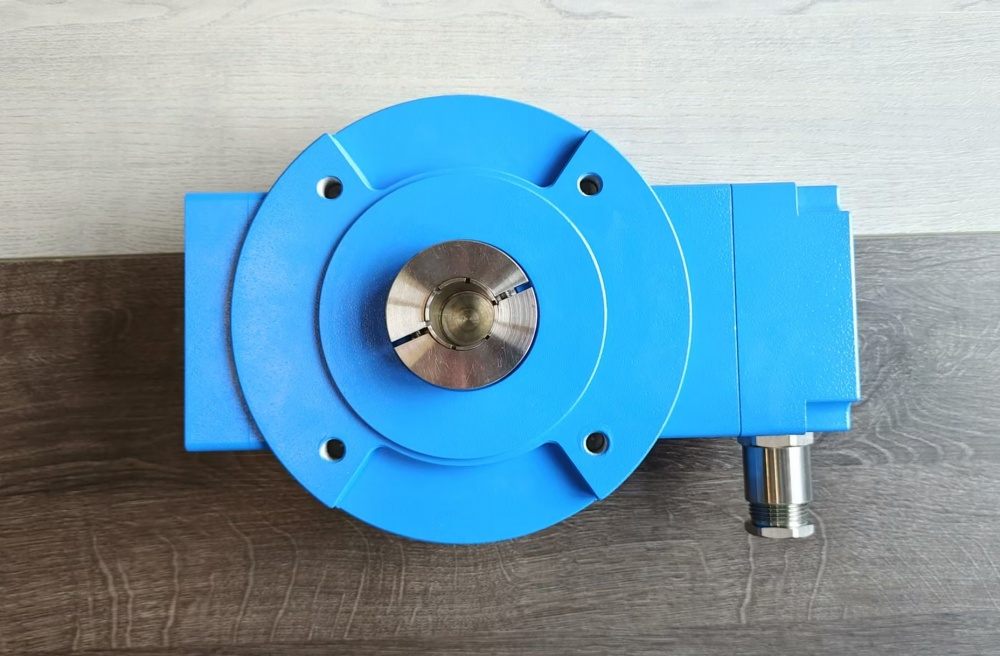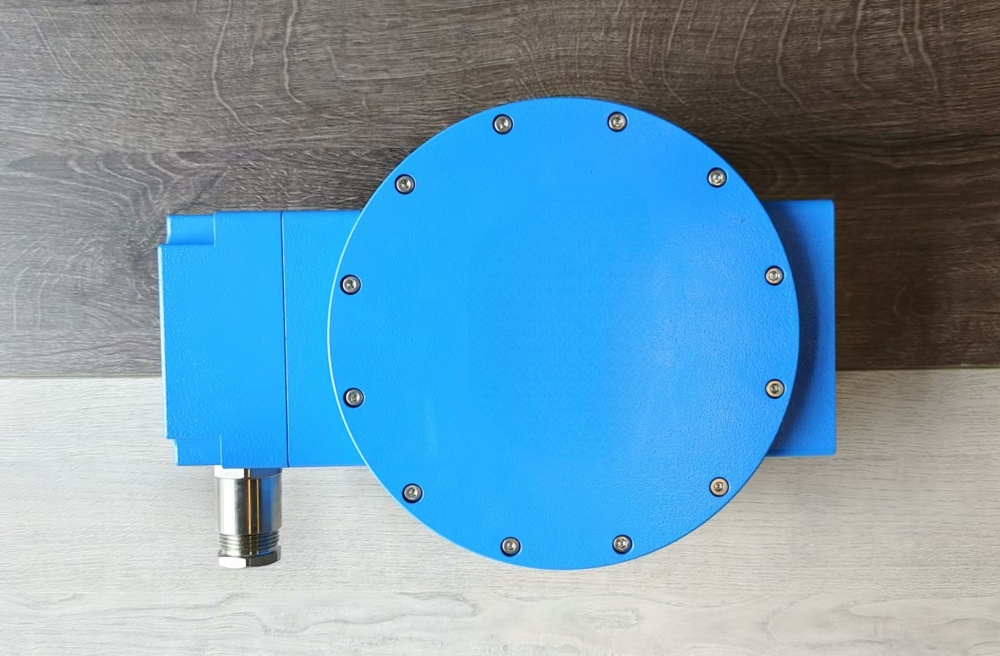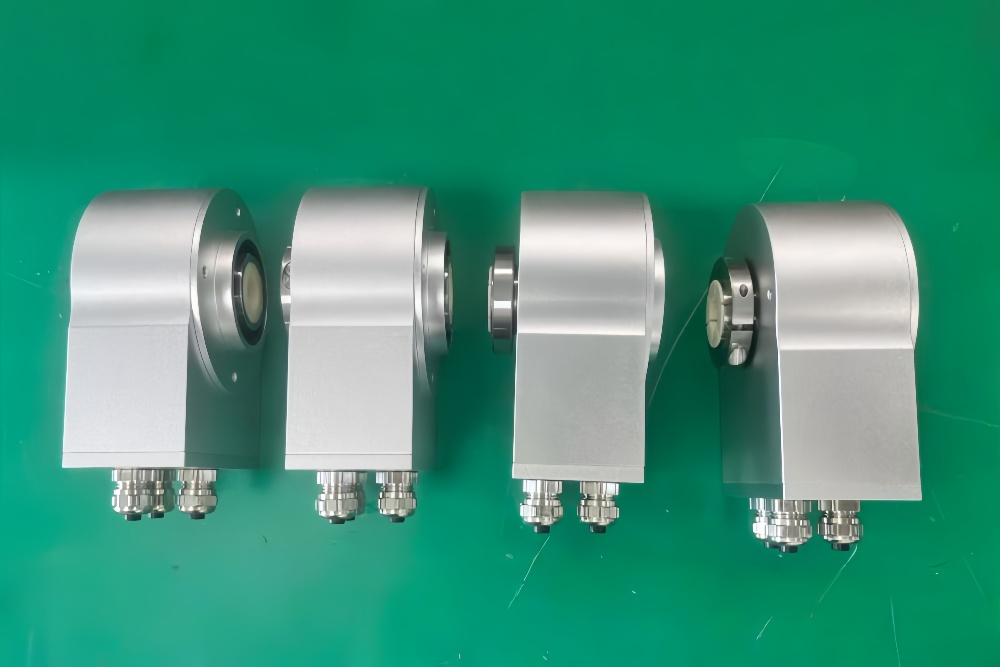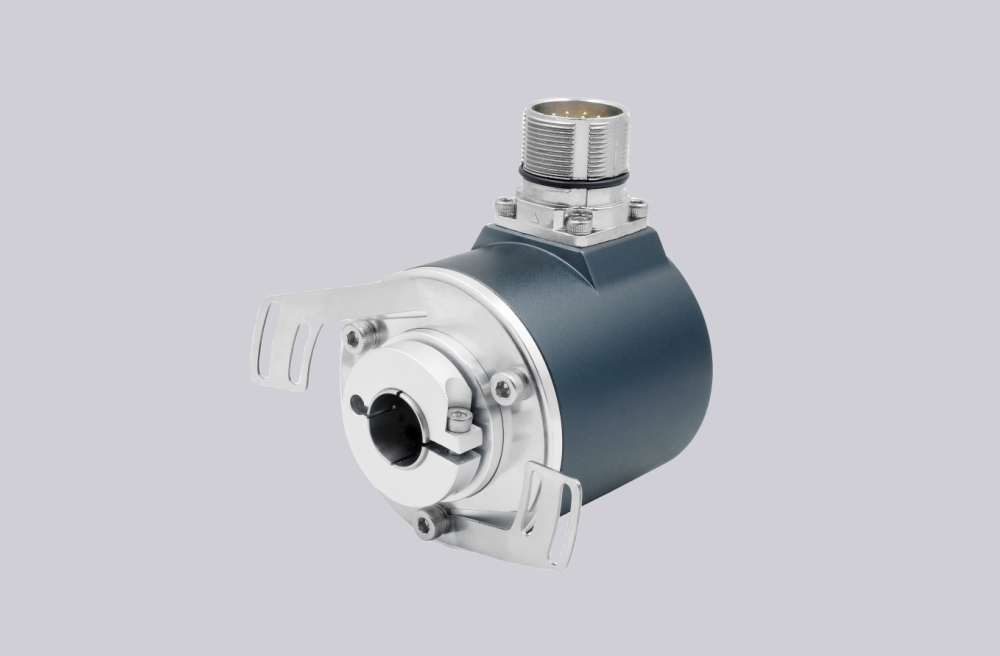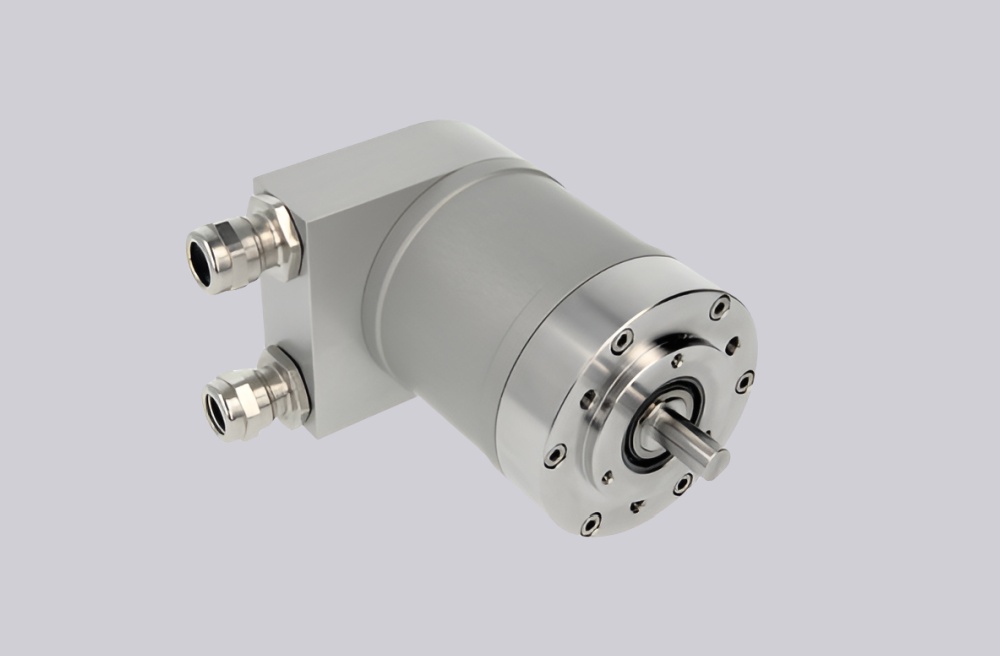




We configured a custom solution for the M6C-4S8HX51ZTZ00 encoder, intended for applications where direct shaft mounting is required and coupling-based solutions are not acceptable due to space, alignment, or mechanical constraints. This configuration uses a 1 inch hollow shaft, end-of-shaft mounting, and a 1024 PPR class output based on the 51 rotor family, with marker signal and conduit-box termination. It is not a tolerance-friendly installation device. It is a controlled mounting solution where shaft fit, anti-rotation behavior, and installation discipline determine whether the feedback remains usable. Typical production lead time: 15 working days under confirmed configuration.
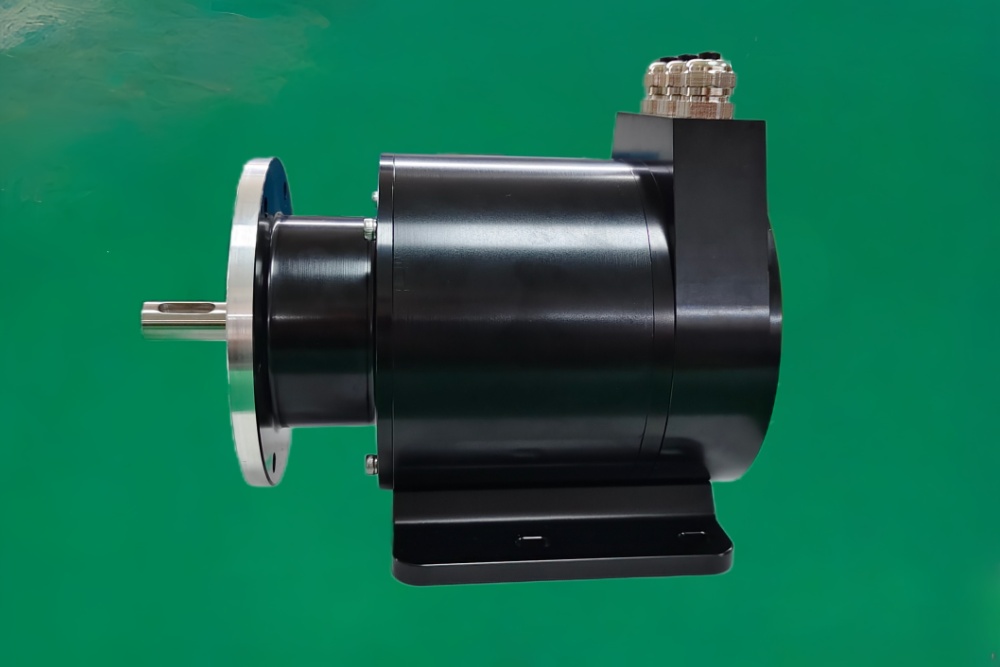
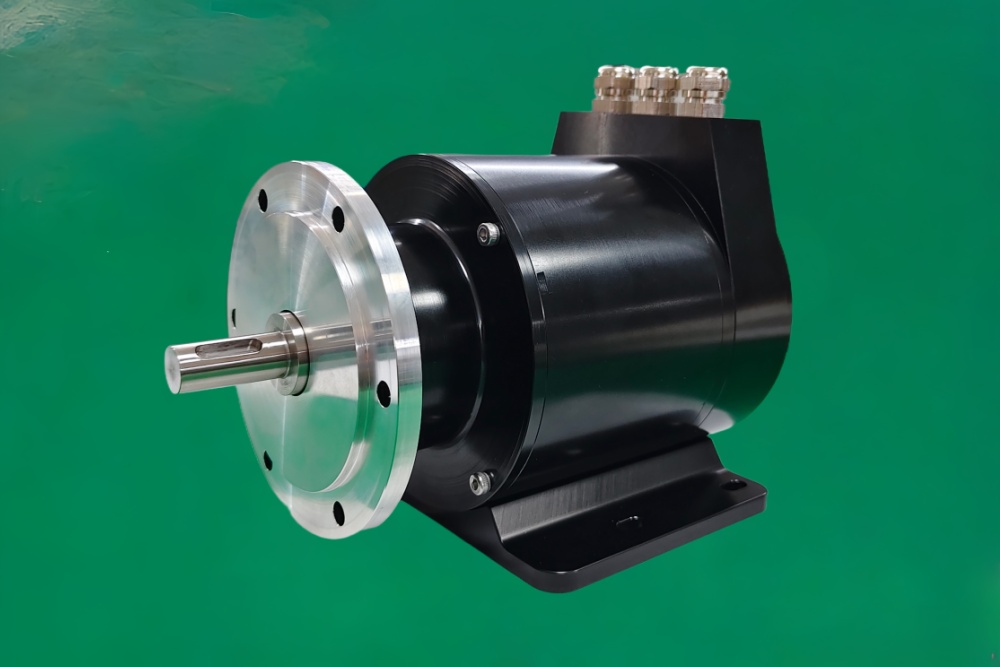
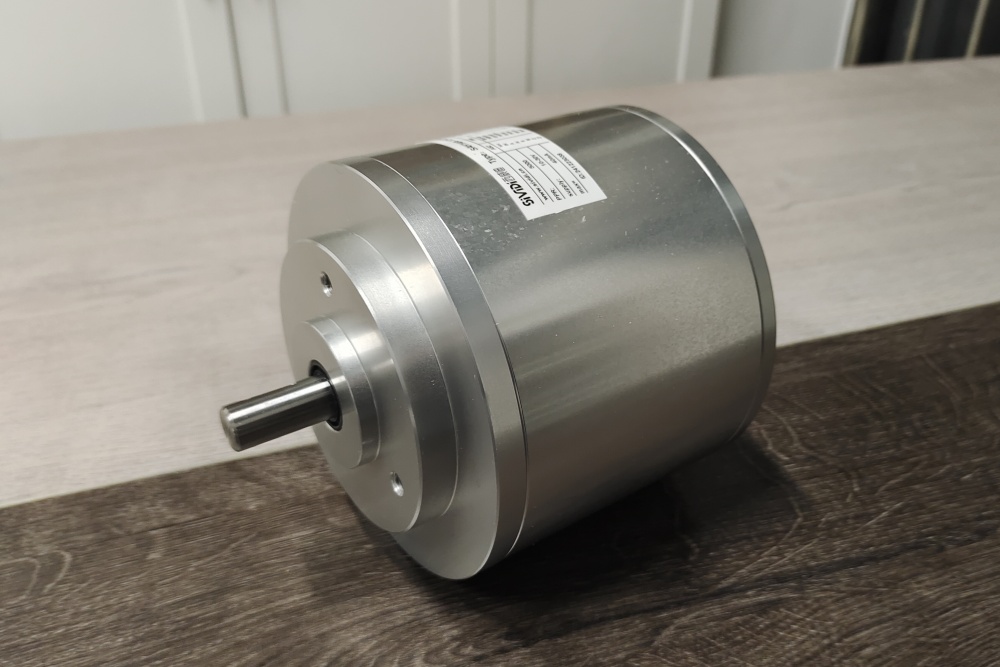
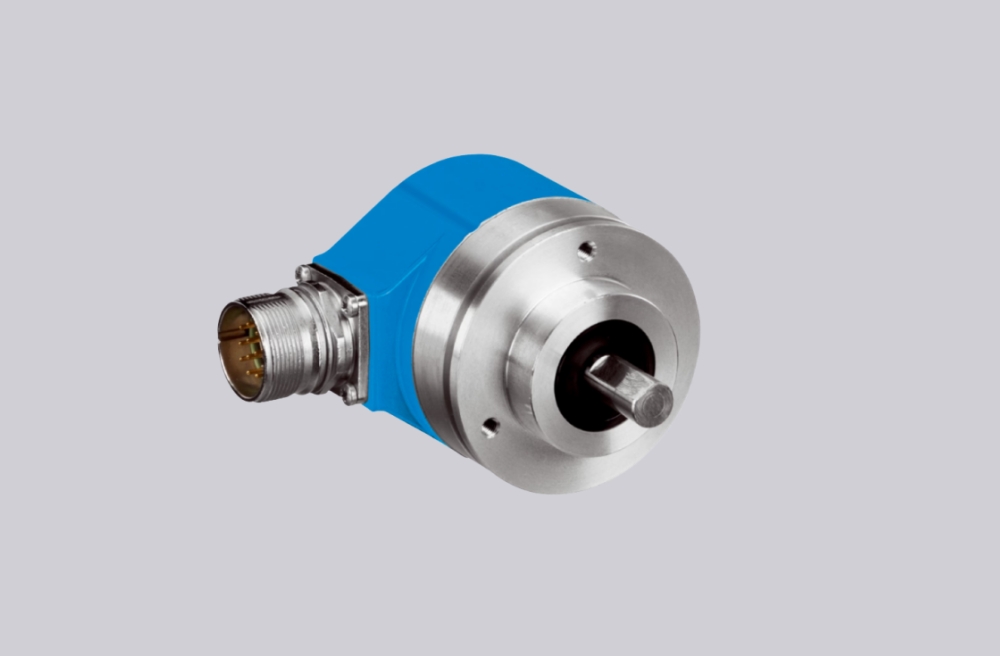
Custom Solution Photos


Output stability in this configuration depends directly on shaft engagement, clamping collar balance, anti-rotation arm geometry, and installation quality shown here.
System Limits
This configuration is limited by shaft runout, housing stability, and mounting accuracy, not by nominal enclosure strength.
The platform supports incremental output up to 250 kHz and mechanical speed up to 5000 rpm, but these values do not define usable performance. In practice, failure is governed by mechanical installation quality.
At higher rotational speeds, even small shaft runout will directly translate into housing wobble, which introduces phase variation and signal instability. If shaft runout exceeds approximately 0.002 inch TIR, signal quality degradation becomes measurable and can lead to unstable pulse output. The encoder does not fail because of structural limits. It fails because the mechanical reference becomes unstable.
Insufficient shaft engagement creates another failure mode. When the encoder is not properly supported along the shaft length, the unit can tilt under rotation, resulting in inconsistent signal timing and increasing phase error even at moderate speed.
Priority of limits:
- Shaft runout becomes the primary limitation before electrical limits are reached
- Housing wobble increases with speed and directly affects signal stability
- Shaft engagement determines whether the encoder maintains positional consistency
This configuration is constrained primarily by mechanical installation conditions, not encoder capability.
Installation and Wiring Constraints
This model must be installed as a controlled hollow shaft system, not as a general-purpose encoder.
- A flexible anti-rotation arm must be used; rigid mounting will introduce stress and instability
- The bracket allows ±0.1 inch shaft end float, but axial positioning must still be controlled
- The encoder must slide onto the shaft without force; forced installation damages clamping elements
- The clamping collar must be tightened evenly to avoid eccentric loading
- Shaft engagement must be sufficient to maintain alignment during rotation
- Cable entry and grounding must follow industrial sealing practices
- The enclosure must not be opened while energized
Field boundary:
- Shaft runout above acceptable range → signal instability increases rapidly with speed
- Poor shaft engagement → tilt and phase inconsistency
- Uneven clamping → eccentric rotation and waveform distortion
- Misaligned installation → increasing harmonic content in signal output
- Improper cable entry → long-term reliability risks
Incorrect installation will invalidate signal performance before any structural limit is reached.
Replacement and Interface Mapping
- Suitable for systems requiring direct hollow shaft mounting without coupling
- Applicable where 1 inch bore fit accuracy and mechanical stability are critical
- Not suitable where shaft tolerance cannot be controlled
- Output format and wiring arrangement can be adapted within the platform
Key Data
- Model: M6C-4S8HX51ZTZ00
- Type: Hollow shaft incremental encoder
- Bore size: 1 inch
- Mounting style: End-of-shaft
- Resolution class: 51 rotor family, approx. 1024 PPR
- Marker: Yes
- Signal type: Incremental square wave, 50 percent ±10 percent duty cycle
- Frequency range: 0 to 250 kHz
- Max speed: 5000 rpm
- Supply voltage: 5 to 24 VDC
- No load current: approx. 120 mA per output
- Maximum additional load: 10 lb axial 30 lb radial
- Protection: IP66
Related Models
- M6C-4S8HX51-W003 Explosion-Proof Incremental Encoder Engineering Solution
- M6C-4S1HX51ZTZ00 Explosion-Proof Incremental Encoder Solution
- M6C-4S1HX51-W003 Explosion-Proof Incremental Encoder Engineering Solution
- M6C-5S8XH51-T005 Explosion-Proof Incremental Encoder Engineering Solution
- M6-4S1HX51ZTZ00 Explosion-Proof Incremental Encoder Solution