

The Role of Standard Housing in SSI Encoder Applications
In industrial automation, standard-housing SSI absolute encoders represent the most commonly applied mechanical configuration.
They are typically selected when environmental conditions are controlled and when the encoder can be mechanically integrated without special protective measures.
Rather than indicating a single mechanical form, standard housing defines a category of encoders designed for conventional industrial installations, where flexibility in mounting and shaft connection is an important consideration.
Standard Housing as a Mechanical Concept
Standard-housing SSI absolute encoders are characterized by:
- Compact cylindrical housings
- Conventional flange mounting options
- Compatibility with multiple shaft interface concepts
From an engineering standpoint, the value of a standard housing lies in its adaptability to different machine designs, rather than in any single structural feature.
This adaptability allows the same encoder concept to be applied across a wide range of automation equipment.
Shaft Interface Options: Solid Shaft and Blind Hollow Shaft
Within standard-housing SSI absolute encoders, two shaft interface concepts are commonly used:
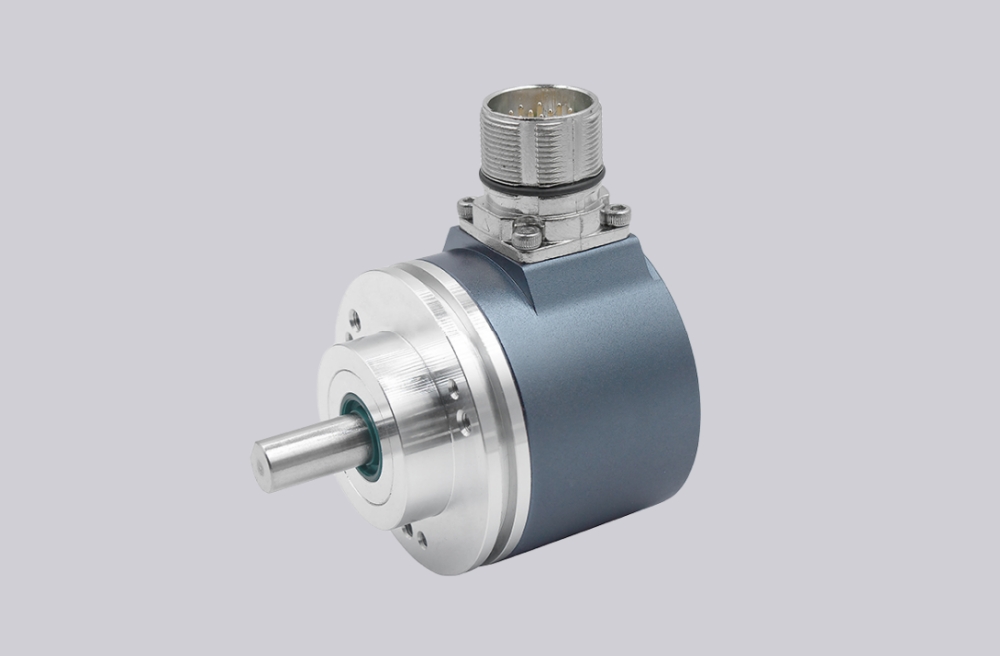
Solid Shaft Configuration
Solid shaft designs are typically combined with flexible couplings and are widely used when:
- Shaft alignment can be mechanically controlled
- Minor radial or angular misalignment needs to be compensated
- The encoder is mounted via a clamping or face flange
This configuration provides a clear mechanical reference and is well suited for general-purpose automation systems.
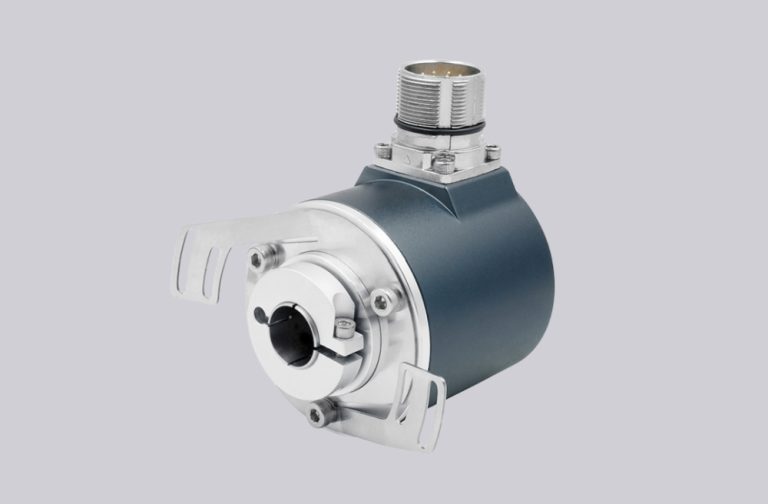
Blind Hollow Shaft Configuration
Blind hollow shaft designs, often used with clamping flanges, allow the encoder to be mounted directly onto an existing machine shaft.
This approach is preferred when:
- Installation space is limited
- A coupling is undesirable or impractical
- Fast and repeatable installation is required
From an engineering perspective, blind hollow shaft configurations reduce the number of mechanical components, but place higher demands on shaft concentricity and mounting accuracy.
Flange Types and Mounting Flexibility
Standard-housing SSI absolute encoders typically support multiple flange concepts, such as:
- Clamping flanges for flexible positioning
- Face-mounted flanges for fixed axial reference
The choice of flange affects:
- Axial positioning accuracy
- Installation repeatability
- Mechanical stress transferred to the encoder bearings
Selecting the appropriate flange and shaft interface together is essential to achieve long-term mechanical stability.
Environmental and Operating Conditions
Standard-housing SSI absolute encoders are intended for:
- Indoor industrial environments
- Moderate temperature ranges
- Controlled exposure to dust and moisture
They are not designed for hazardous areas or extreme mechanical stress.
Within their intended operating range, however, they offer a reliable balance between compact size and mechanical robustness.
Functional Characteristics in Automation Systems
Functionally, standard-housing SSI absolute encoders provide:
- Deterministic absolute position output via SSI
- Immediate position availability after power-up
- Stable signal transmission in electrically noisy environments
In practical applications, system performance is often limited by mechanical factors rather than by encoder resolution or signal processing capability.
Typical Application Scenarios
Standard-housing SSI absolute encoders are widely used in:
- Packaging and assembly machinery
- Conveyor and material handling systems
- Machine tools and positioning axes
- General automation equipment
Their mechanical flexibility allows them to be adapted to different machine layouts with minimal redesign.
Retrofit and Replacement Considerations
For retrofit projects, standard-housing SSI absolute encoders are often selected because:
- Shaft and flange interfaces are widely standardized
- Mechanical integration effort is relatively low
- Existing mounting concepts can usually be retained
Special attention should be paid to the original shaft interface concept when selecting a replacement encoder, as solid shaft and blind hollow shaft designs are not mechanically interchangeable.
When Alternative Designs Should Be Considered
A standard-housing SSI absolute encoder may not be suitable when:
- The application involves hazardous or explosive atmospheres
- Direct hollow-shaft mounting with through-shaft is required
- Continuous shock, vibration, or aggressive contamination is present
In such cases, explosion-proof or heavy-duty encoder designs provide better long-term reliability.
Engineering Summary
Standard-housing SSI absolute encoders form the baseline for most industrial automation applications.
Their key advantage lies in mechanical flexibility, offering both solid shaft and blind hollow shaft configurations combined with standardized mounting options.
Understanding these mechanical concepts allows engineers to select an SSI absolute encoder that integrates reliably into the machine design without unnecessary complexity.

Comments (0)